

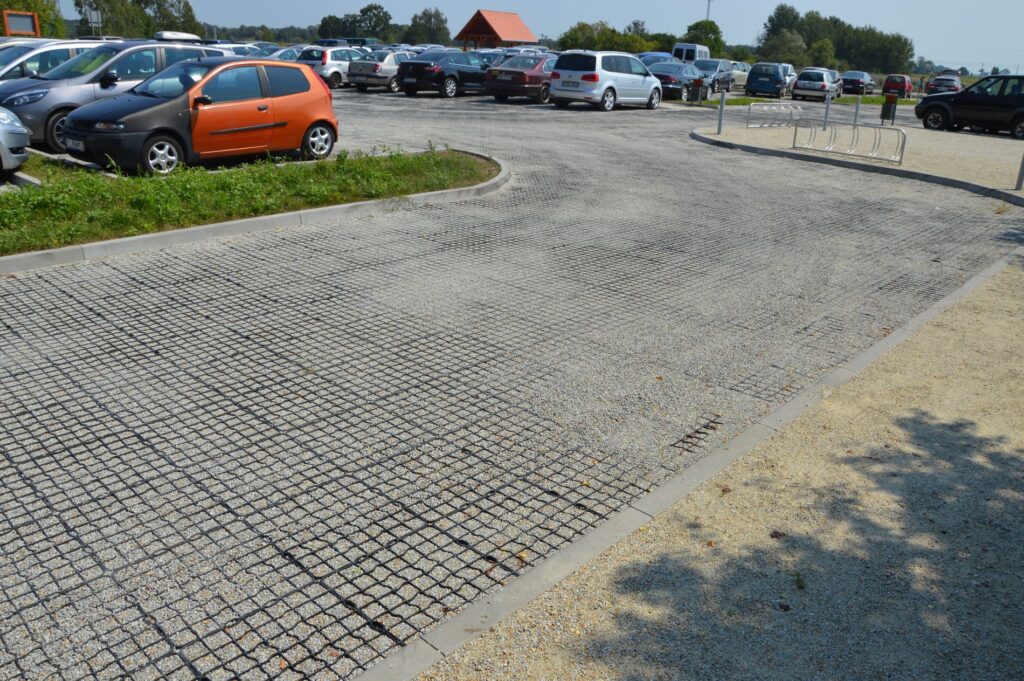
Maintaining roadsides in proper technical condition is a key aspect of safety and durability of public roads. Ecogrid offers a modern solution to the problem of rutting and degradation of asphalt edges caused by heavy vehicles, reducing the costs of ongoing road infrastructure maintenance.
- Edge stabilization: Installing the grids at the interface between the bituminous pavement and the soil roadside absorbs the impact energy and prevents asphalt edge chipping.
- Resistance to shear forces: The cells prevent the aggregate of the roadside from being spread by vehicle tires, keeping the fill material in place.
- Permeability: Water flowing off the profiled roadway freely infiltrates into the ground through the grids, eliminating the risk of water pooling and aquaplaning.
Implementation example: The modernization of a provincial road with high transit traffic, where standard crushed stone shoulders required constant leveling. The application of the grid system on a 1-meter-wide strip reduced roadside maintenance costs by 80% over 5 years.
Key investment benefits:
- Extended lifespan of the bituminous pavement thanks to protection of its lateral edges.
- Dramatic reduction in financial outlays for regular replenishment and profiling of roadsides.
- Increased safety for road users through a stable surface in case of an emergency pull-off.
Recommended models for this application: The requirements of road infrastructure are best met by models with the highest load-bearing index and resistance to dynamic loads: Hydrogravel and the grid from the PRO series.
Frequently Asked Questions
Short answers — expand a question to see details.
The system installed according to best practice (where the top of the grid is flush with the asphalt level or slightly below) is safe. A plow striking it does not cause the modules to be pulled out.
Recycled polyethylene (HDPE/LDPE) is completely chemically inert, guaranteeing resistance to sodium chloride (road salt) and petroleum-derived substances.