

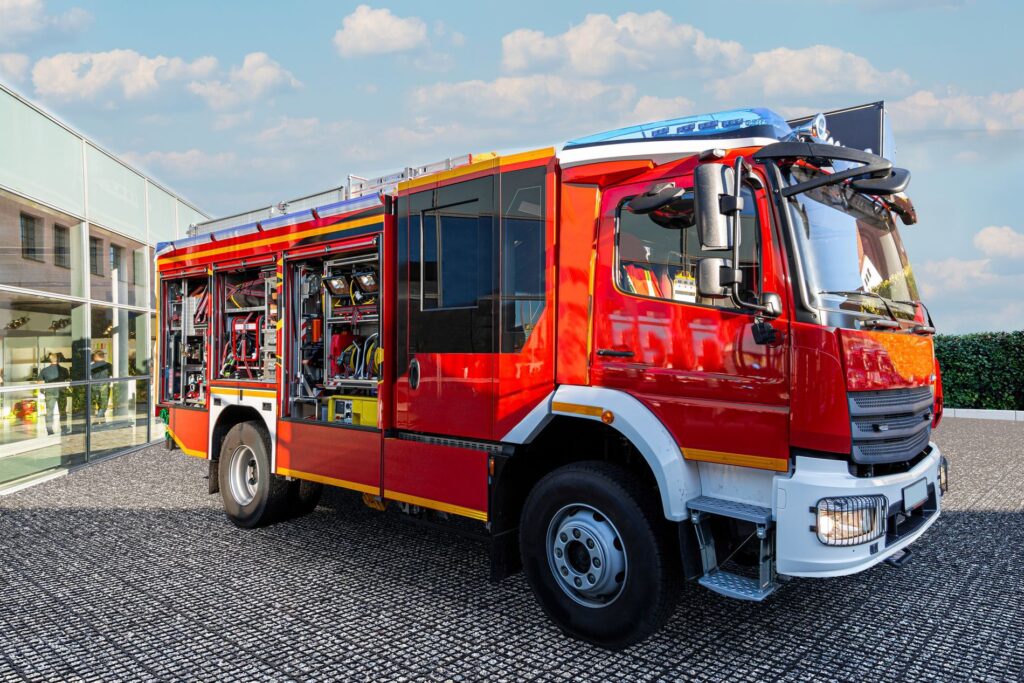
Maneuvering area, access roads for garbage trucks, fire roads, or depots for delivery vehicles require reliable and extremely durable surfaces.
Find out how optimized, heavy Ecogrid road grids with reinforced walls create surfaces adapted to intensive traffic of construction machines and trucks.
Use of Ecogrid in heavy traffic and industry
Although geogrids are often associated with the architecture of home spaces, the construction industry successfully uses them for special tasks and work under maximum load.
Technical specification and mechanism of operation
- Reinforced construction: Models dedicated to heavy traffic feature thickened, massive walls arranged in a dense geometric structure. They have noticeably higher weight, and their height is usually 50 mm.
- Force vector distribution: The key to carrying extreme loads is even pressure distribution. Modules properly supported with load-bearing layers effectively distribute the point pressure of multi-ton truck wheels over a large ground surface.
Practical use and ground protection
- Surface stabilization: The use of industrial grids completely eliminates the risk of ground tearing and pothole formation – it protects the area even during demanding maneuvers, such as turning the wheels of large vehicles in place.
- Versatility: Due to their reliability, these solutions are widely used in the most demanding locations, such as storage yards, helipads for rescue helicopters, or intensively used camping areas.
Durability under maximum load The use of grids with advanced strength parameters guarantees that the surface will meet rigorous industrial requirements, retaining full structural stability.
Cost-effective solution for logistics and industry
Using eco-friendly plastic mats on maneuvering areas saves on environmental taxes and significantly accelerates the pace of commissioning the investment compared to classic road works.
You get express hardening of huge areas without pouring and vibrating concrete.
You effectively prevent machines from sinking in mud after autumn and spring thaws.
You meet stringent building standards for environmental protection.
Frequently Asked Questions
Short answers — expand a question to see details.
For servicing trucks (over 3.5t), you should absolutely choose models certified for a load capacity of 300 to 500 tons per square meter.
For purely practical reasons, on maneuvering areas, aggregate (grit, crushed stone) works much better than grass, which could be destroyed by constant tire torsional forces.
Yes, heavy traffic requires a thick load-bearing layer (crushed stone) with a thickness of at least 45-60 cm depending on the cohesion of the local soil.