

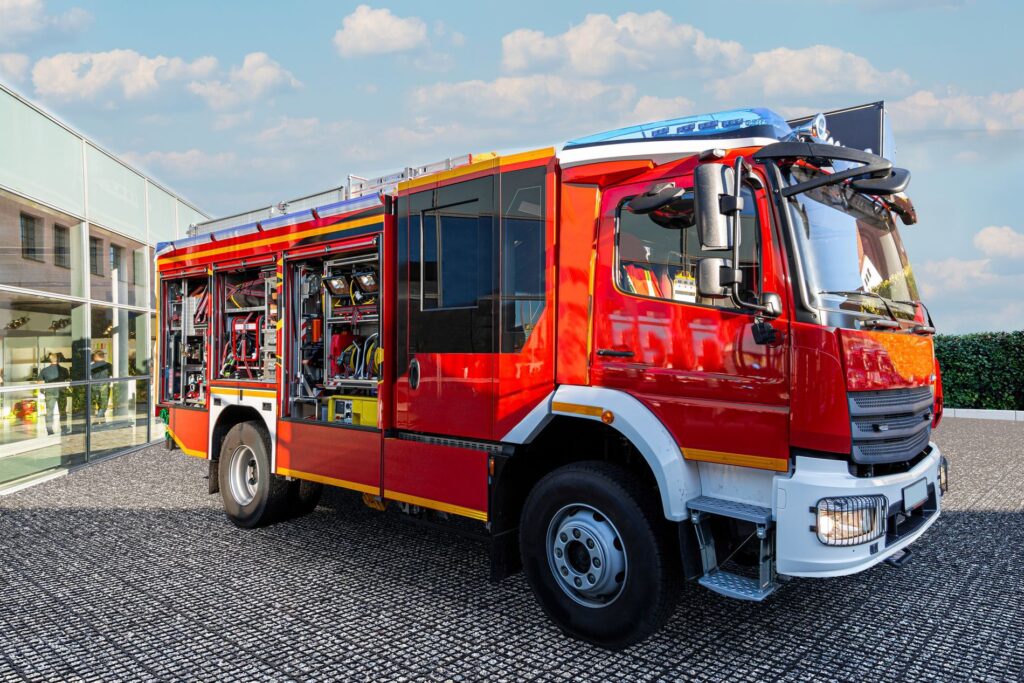
Designating emergency access routes imposes strict standards for ground load-bearing capacity. Grass grid systems allow for marking out an invisible fire lane that visually forms an integrated part of the landscape architecture, while technically it can carry the weight of a State Fire Service fire engine.
- High normative load capacity: Fire lanes must guarantee an axle load of at least 100–115 kN (depending on road class). Grid systems stabilize the base and provide the required load capacity.
- Root system protection: The grid walls take over the full wheel load, preventing soil compaction and lawn degradation.
- Biological continuity: They enable maintaining an aesthetic green zone within the courtyards of office buildings and housing estates.
Implementation example: A representative courtyard of a Class A office building, through the middle of which a strip of lawn has been laid out as an official, certified fire lane. The surface remains green and functional all year round.
Key investment benefits:
- Increasing the investment’s commercial area thanks to dual land use (recreation zone + evacuation route).
- Full compliance with applicable fire safety regulations, confirmed by declarations of performance.
- Enhancing the aesthetic values and prestige of the facility.
Recommended models for this application: For fire protection applications, the highest-class models are recommended, guaranteeing maximum strength parameters: Hydrogravel and PRO grids.
Najczęstsze pytania
Krótkie odpowiedzi — rozwiń wybrane pytanie, żeby zobaczyć szczegóły.
No, maintenance is standard. The module construction actually supports vegetation, creating micro-retention reservoirs that collect moisture.
Yes, the polymers our systems are made of are fully resistant to road salt, oils, and extreme temperature fluctuations.