

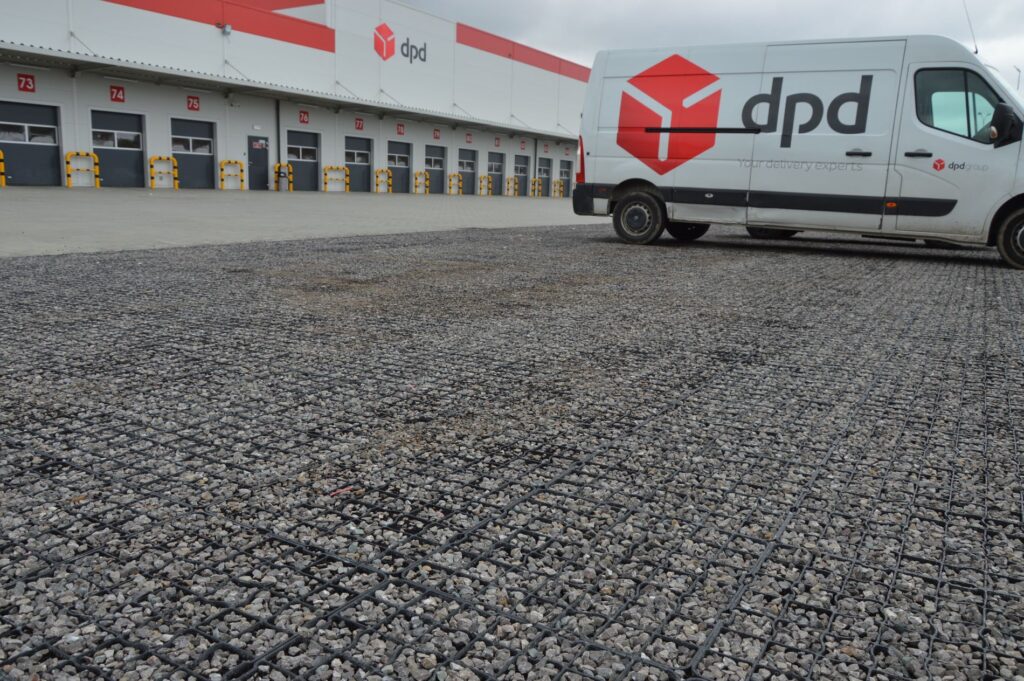
External storage areas and stockyards require a hard and stable surface that, on one hand, withstands long-term static pressure from stored goods, and on the other, enables trouble-free logistics operations. Ecogrid is a highly efficient alternative to concrete slabs, ensuring full load-bearing capacity while maintaining ground permeability.
- Point load resistance: The cellular structure filled with appropriate aggregate prevents the feet of external racks, pallets, and heavy building materials from sinking into the ground.
- Operational continuity: The system’s full permeability eliminates the formation of puddles after rainfall, allowing forklifts and loaders to operate safely without the risk of slipping or getting stuck.
- Product protection: A dry and stable surface prevents moisture from wicking up from the ground, protecting materials stored at the lowest level from degradation.
Implementation example: Hardening of an external yard at a building materials wholesaler for storing pallets with paving stones and reinforcing steel. The use of the grid system allowed the investor to quickly put the yard into use without waiting for concrete to cure, while also avoiding the costs of building linear drainage.
Key investment benefits:
- Rapid investment process – the yard is ready for full load immediately after filling and compacting the aggregate.
- No issues with surface cracking in winter (a common problem with concrete floors exposed to frost and heavy loads).
- Easy expansion of the storage yard in the future thanks to the system’s modular design.
Recommended models for this application: To handle the highest static loads (heavy pallets) and dynamic loads (forklifts), models with the highest stiffness and load capacity are necessary: Hydrogravel and Plus grids.
Najczęstsze pytania
Krótkie odpowiedzi — rozwiń wybrane pytanie, żeby zobaczyć szczegóły.
Use crushed aggregate (sharp-edged) that interlocks well. The fraction should be fine (e.g., 2–8 mm), and the material should be filled with a minimal surplus (approx. 1 cm above the grid) and compacted, creating a smooth surface for small forklift wheels.
No. In a properly installed system, the load is transferred through the compacted aggregate inside the cells and the grid walls to the load-bearing base layer. When using the highest-strength models, the risk of deformation under static load is eliminated.