

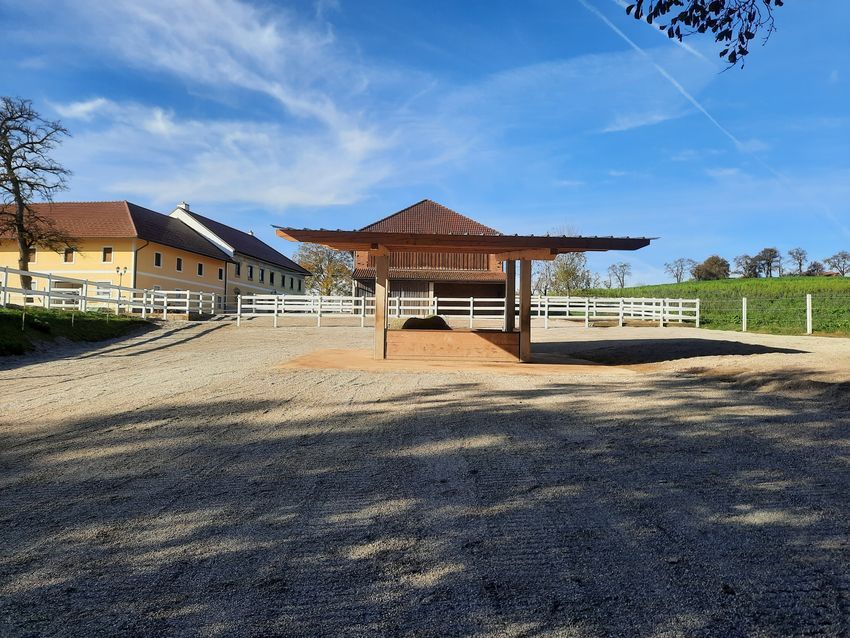
Maintaining professional equestrian infrastructure requires eliminating the problem of deep mud, which is a direct cause of hoof diseases (e.g. thrush) and tendon injuries in horses. Ecogrid is a specialized solution that allows creating a stable, flexible, and dry surface on paddocks, turnout areas, and horse walkers.
Pressure resistance: The cellular construction effectively disperses the high point pressure generated by a horse’s hoof (regardless of whether the horse is shod or not).
Surface flexibility: Unlike concrete, the grid filled and covered with an appropriate abrasive layer (e.g. quartz sand) provides micro-cushioning that protects animals’ joints.
Continuous drainage: Urine and rainwater are immediately drained into the base layer, which helps maintain hygiene and makes daily removal of manure from turnout areas easier.
Example implementation: Hardening the high-traffic zone around feeders and waterers at a commercial sports horse stud. Eliminating knee-deep mud improved herd health, significantly reduced veterinary costs, and made stable staff’s work easier.
Key investment benefits:
Ensuring the highest standards of animal welfare, which attracts customers to horse boarding facilities.
- Fast and easy mechanical cleaning of paddocks (e.g. with a loader with scraper), without the risk of removing expensive aggregate together with manure.
- Possibility of year-round use of turnout areas, regardless of heavy rain and snowfall.
Recommended models for this application: For equestrian and breeding centers, an appropriate wall structure is required, so the ideal solution will be reinforced models N50 PRO / PLUS and N40 PRO / PLUS, and in areas exposed to heavy agricultural equipment traffic, the HYDROGRAVEL grid.
Najczęstsze pytania
Krótkie odpowiedzi — rozwiń wybrane pytanie, żeby zobaczyć szczegóły.
A properly constructed equestrian surface assumes that there is a so-called abrasive/working layer above the grid (approx. 3-5 cm of quartz sand with the addition of e.g. nonwoven fabric clippings). The horse’s hoof works in this layer and never comes into direct, slipping contact with the top of the plastic.
In critical places, a thicker drainage base layer (e.g. crushed stone) should be used, separated from the ground with geotextile fabric, and only then should the cellular module system be laid on such a base.